SlopFilter
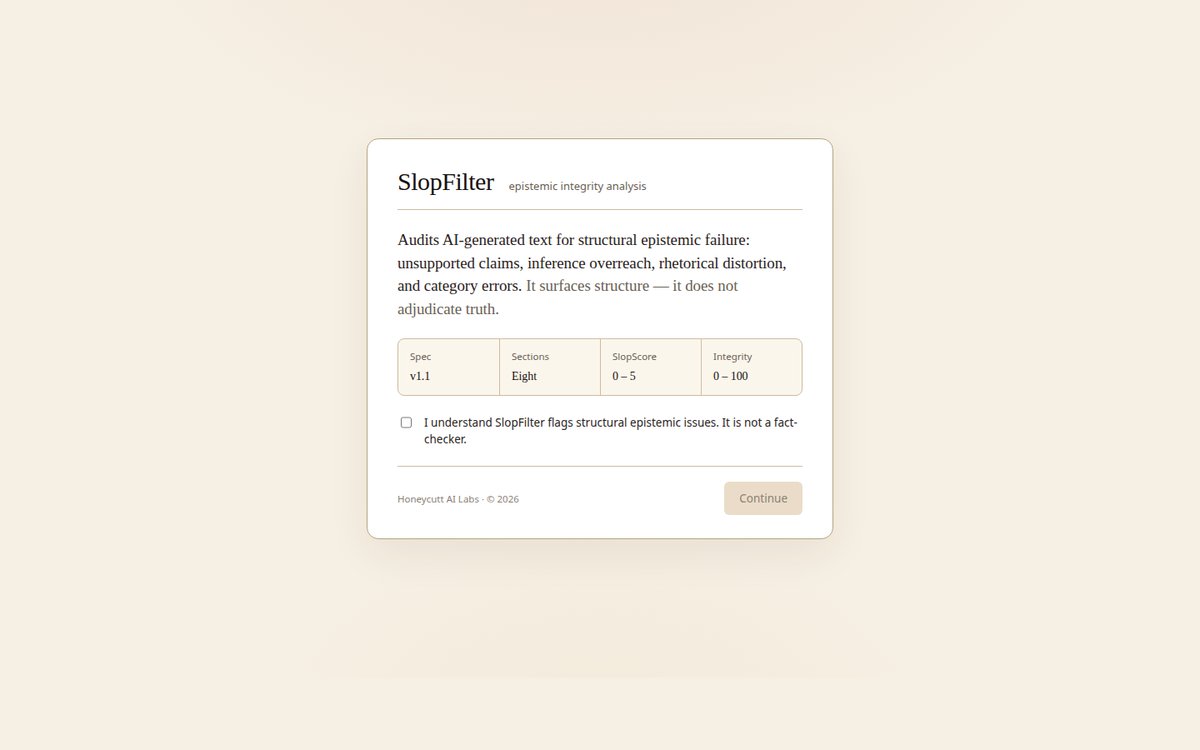
Hosted quality analysis for AI-generated and AI-adjacent text. It scores writing against the markers of narrative pressure and thin sourcing, so a reader can tell confident prose from evidenced prose.
Research practice · Princeton, Texas
Honeycutt Ai Labs takes a manuscript, a corpus, or a question too large to work through by hand — and returns a research record you can defend. Every claim traces to a primary source. The weak ones are tested in the open, not buried.
The service
The lab does one thing: it takes a body of sources too large or too tangled to work through by hand, and turns it into a structured research record — acquisition, close reading, cross-checking, and an adversarial review that attacks the findings before you ever see them.
What comes back is tiered by how well each claim is supported — settled, supported, or still open — with every citation resolved and every contradiction surfaced. Nothing rests on trusting a black box. You can follow the reasoning, and you can break it if it deserves to be broken.
The proof
Before offering this as a service, the lab pointed the same process at the Voynich Manuscript — one of the most-studied unsolved documents in medieval scholarship.
The result is a working record of hundreds of findings on the manuscript, its comparator manuscripts, and its scribal context. Each is tied to a primary source and ranked by strength of evidence, and the claims that failed are kept visible instead of deleted. No decoder hype, no we cracked it — just a defensible account of what the evidence supports.
The current write-ups are public at thevoynich.org.
On the record
Public Zenodo deposits from the lab's working record. Each entry resolves to a primary source you can read, cite, or break. Listed shelfmark-first; no decoder hype.
Dataset deposit anchoring the lab's Paduan medical comparator set to its August 2025 priority date. Held as the standing anchor for the manuscript-mode work that follows.
A twenty-lens template return on Giovanni Fontana's cipher practice with a negative-control differential — signal ratio 3.17× over the control, reported in the open.
A seven-witness substrate-anchored inventory of Jacques Despars' Avicenna Canon tradition, 1431-1498. Witnesses, dates, and the chain of inference are laid out for re-checking.
Five convergent lines of evidence for constitution-archetype encoding across the zodiac quires, read as a ten-sign lunar structure rather than the conventional twelve-by-thirty grid.
A substrate-grammar distinguishability argument across thirteen folios, closing the constructed-cipher class as a falsifiable proposition rather than a rhetorical one.
A field report on how production language models steer conversations away from architectural self-examination, with replication notes and the operator-side fingerprints that make the pattern visible.
First step in the Hartlieb-comparator iterated protocol, worked against Voynich folio 58r. Procedure, decisions, and falsifiers are kept on the page so the reading can be rebuilt or broken.
Second step of the protocol applied across the Voynich balneological quire. Each lens and its result is reported in the open, including the readings the evidence did not support.
Third-step extension of the protocol into the Voynich herbal pages, with comparator alignments and the open falsifiers that remain after the pass.
+ Additional deposits forthcoming.
On the web today
Working demo
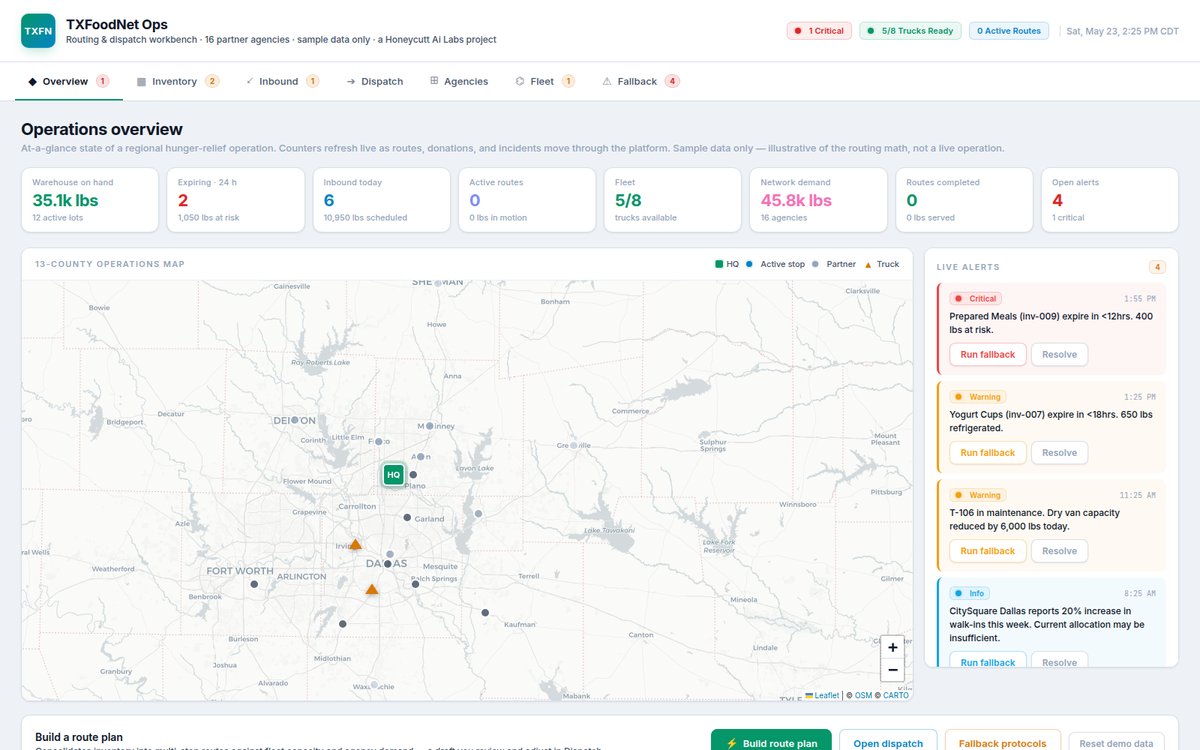
A working operational model of a regional food bank: six route types from scheduled multi-stop delivery through hot-shot to mobile pantry, pallet-position bin-packing, stop sequencing, and a dispatcher-in-the-loop board. Built to show what the food-redistribution concept looks like when the routing math is real.
Built by the lab
Hosted quality analysis for AI-generated and AI-adjacent text. It scores writing against the markers of narrative pressure and thin sourcing, so a reader can tell confident prose from evidenced prose.
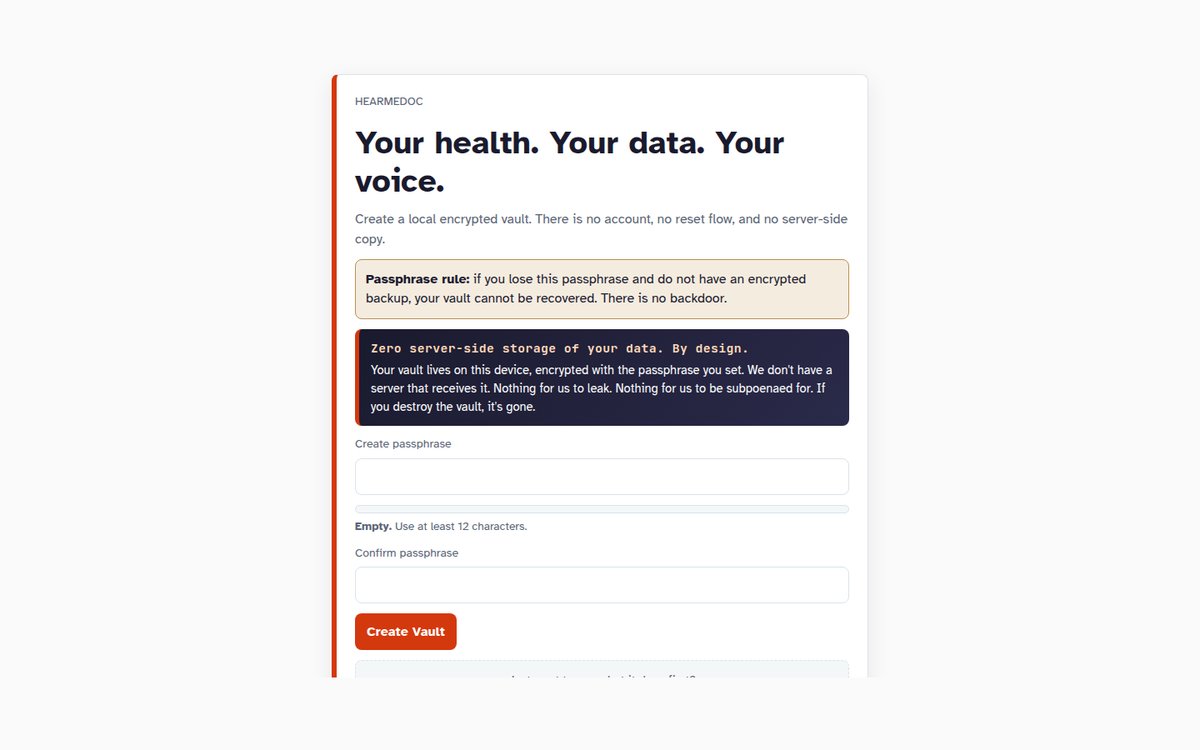
A local-first medical-record vault built so a patient can carry their own history into a visit and be heard the first time. Built to a hard privacy posture — nothing leaves the device unless the patient sends it.
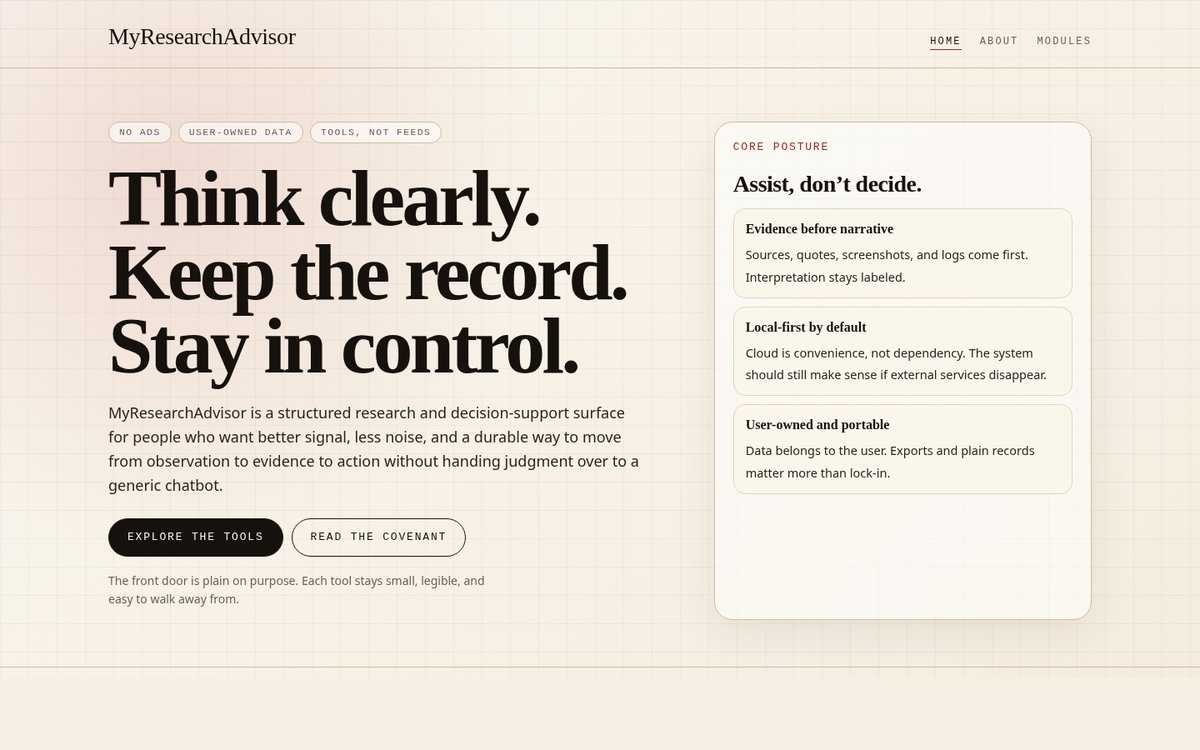
A research platform that carries a rough question through to a citation-anchored result without leaving the page — source-first and falsifier-aware throughout.
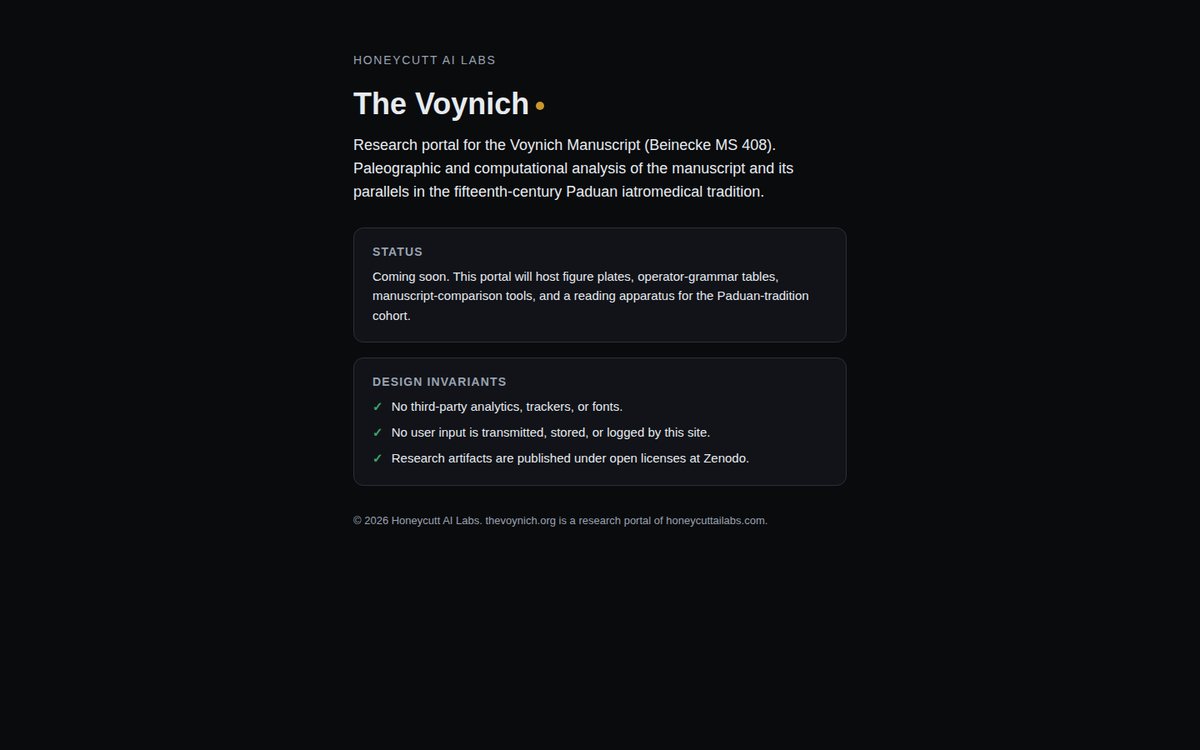
The public face of the lab's Voynich research — primary-source citations and explicit non-claims, not decoder theatre. The clearest example of how the lab presents its work.
A routing & dispatch workbench for a regional hunger-relief operation — 16 partner agencies across a 13-county footprint, inventory and fleet against agency demand. Sample data only; illustrative of the routing math, not a live operation.
The lab's civic and humanitarian projects are on the Work page.